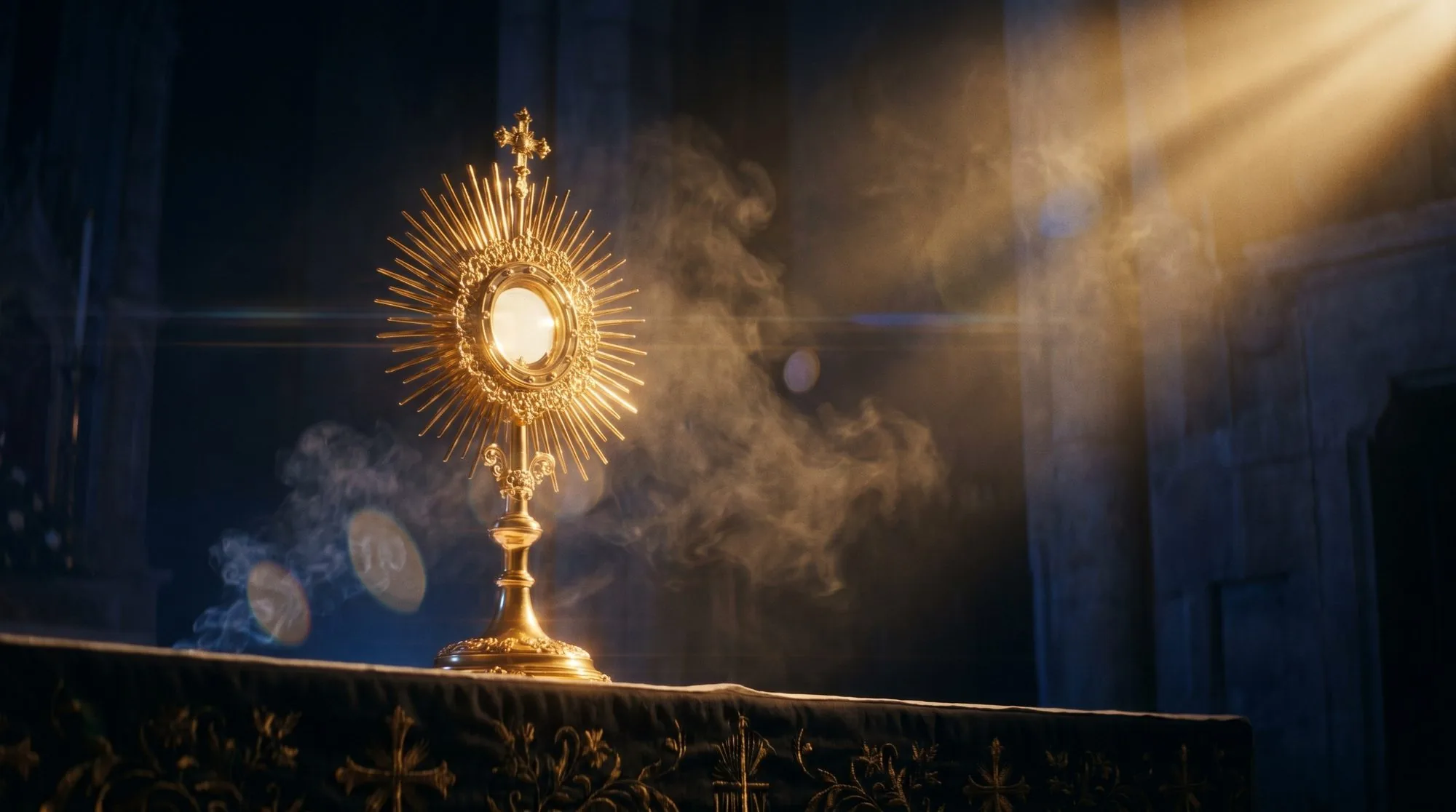
Of everything the Catholic Church believes, this is the claim that sounds most impossible to modern ears — and the one she has never once softened. The bread and wine of the Mass are not symbols of Christ. They are Christ: His Body and Blood, truly, really, and substantially present.
The claim Jesus refused to take back
In the sixth chapter of John’s Gospel, Jesus tells a crowd that the bread He will give is His flesh, and that unless they eat His flesh and drink His blood they have no life in them. The crowd is scandalized. This is a hard saying, they protest — and many walk away.
Here is the detail that matters: Jesus does not call them back. He does not say, “Wait, I meant it as a metaphor.” He lets them go, and turns to the Twelve to ask if they will leave too. When a speaker watches a crowd abandon Him over a misunderstanding and refuses to correct it, He was not being misunderstood.
This is My Body
At the Last Supper the words are plain. Taking bread, Jesus says, “This is My Body.” Over the cup, “This is My Blood.” Not this represents, not this stands for. He commands the apostles to do this in memory of Him, and the Church has done exactly that at every Mass since.
St. Paul, writing to Corinth only about twenty years after the Resurrection, treats it as utterly real. He warns that anyone who eats the bread or drinks the cup unworthily sins against the Body and Blood of the Lord. You cannot sin against a symbol.
Whoever eats the bread or drinks the cup of the Lord unworthily will be answerable for the body and blood of the Lord.1 Corinthians 11:27 (paraphrased)
Transubstantiation: a word for a mystery
How can bread be Christ while still looking, tasting, and feeling like bread? The Church uses a precise term: transubstantiation. The substance — what the thing most truly is — becomes the Body and Blood of Christ, while the appearances of bread and wine remain. The Catechism, drawing on the Council of Trent, teaches that by the consecration the whole substance of the bread is changed into the substance of Christ’s Body, and the whole substance of the wine into His Blood.
It is not a chemical claim, and it is not magic. It is a claim about the deepest level of what a thing is — the level God alone touches.
Why it changes everything
If this is true, the Mass is not a memorial service or a moving symbol. It is an encounter with the living God under the humblest of veils. The Catechism calls the Eucharist the source and summit of the Christian life — the center toward which everything else flows and from which everything else draws strength.
It also reframes the whole of Catholic worship. The kneeling, the silence, the gold, the incense — none of it is theater. It is the only sane response to the belief that God Himself is on the altar.
Symbol or substance is not a small theological footnote. It is the difference between a beautiful tradition and an actual meeting with God. The Church has staked two thousand years on the second.
Sources: John 6:51–56; Luke 22:19–20; 1 Corinthians 11:23–29; Catechism of the Catholic Church, 1324, 1374, 1376; Council of Trent, Session XIII.